3D Solar System Planets Simulation
High-performance WebGL celestial orbital mechanics engine built with Three.js and React
Project Overview
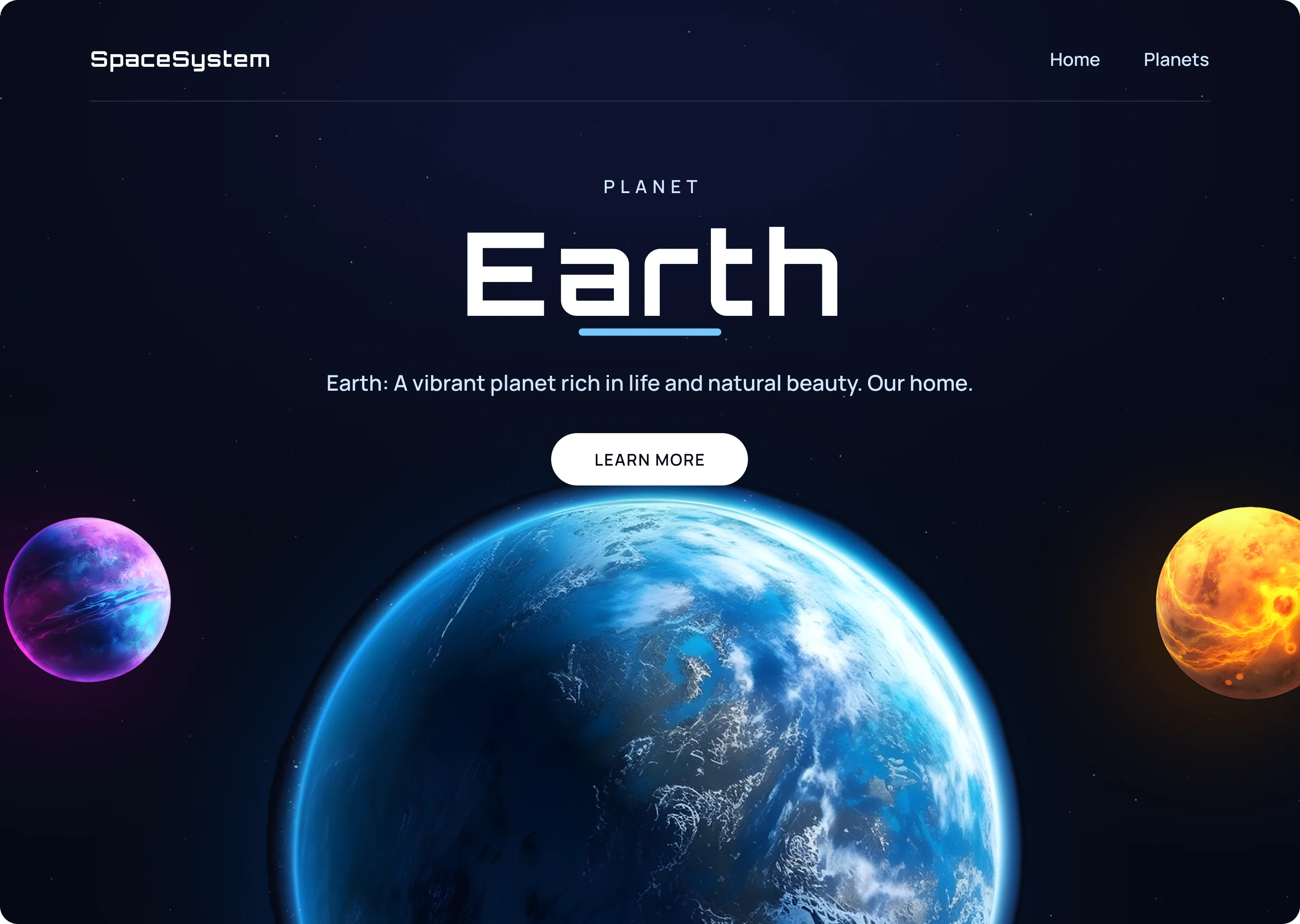
A mathematically grounded, interactive 3D simulation of celestial planetary bodies within our solar system. Designed to render orbital trajectories, custom atmospheric shaders, and dynamic lighting transitions smoothly across all devices at 60 FPS.
WebGL Scene Graph & Shader Architecture
Engineered using a modular Three.js scene architecture decoupled from React's render loop to eliminate unnecessary re-renders during high-frequency animation ticks.
- Hierarchical scene graph modeling gravitational parent-child relationships and orbital eccentricities.
- Custom GLSL fragment and vertex shaders simulating planetary atmospheric light scattering.
- Resource lifecycle management ensuring zero GPU texture memory leaks upon component unmounting.
Engineering Challenges & Solutions
Sustaining 60 FPS across low-power mobile GPUs
Implemented adaptive Level of Detail (LOD) rendering and instanced meshes for asteroid belts, dynamically throttling shadow map resolution on low-tier devices.
Spherical UV texture distortion at polar regions
Utilized high-resolution equirectangular texture maps paired with custom normal mapping shaders to preserve surface detail without texture stretching.
Core Capabilities
- Real-time orbital tracking with accurate scale velocity adjustments
- Interactive 360-degree orbit and pinch-to-zoom camera controls
- Dynamic celestial lighting calculated from the central sun light emitter
- Informational telemetry overlays for each planet's diameter, distance, and orbital period
Validated Outcomes
- Stable 60 FPS performance maintained across mobile and desktop test environments
- Zero GPU memory leakage verified through Chrome Performance tooling
- Featured as an open-source educational WebGL demonstration